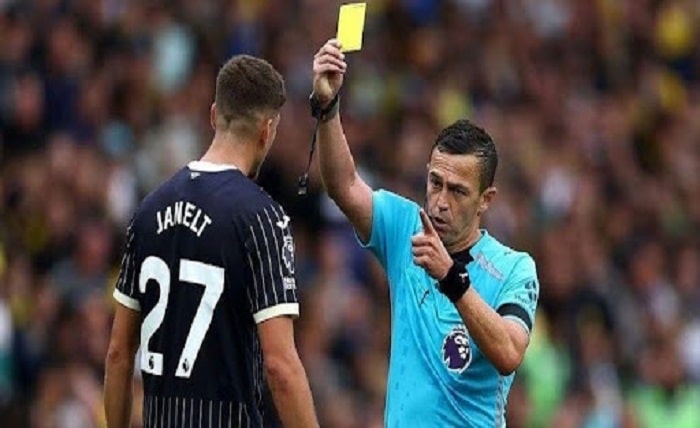
Yellow card the tactical equilibrium shifts instantly as cautioned defenders forfeit their freedom to commit disruptive transitional fouls. Savvy football punters treat disciplinary markets as uncorrelated mathematical opportunities where match winners. Registering at 8XBET unlocks real-time card point spreads, fast bet confirmation.
Officiating intervention benchmarks and referee yellow card tendencies
At 8xbet , Tracking quantitative officiating behaviors exposes high-value pricing yellow card long before pre-match lines close. Referee personality profiles directly dictate whether an aggressive encounter escalates into an extended sequence of cautions.
| Referee Intervention Metric | Quantitative Benchmark | Yellow Card Impact | Analytical Significance |
| Fouls per Caution Ratio | Strict referees: around 3.8 fouls per card; permissive officials: over 7.2 fouls per card | A stricter referee can raise the probability of an early yellow card by approximately 41% | Historical referee profiles help identify deviations from standard booking lines such as 4.5 total cards |
| Early Warning Escalation | Three verbal warnings within the opening 20 minutes may precede an 84% chance of a card on the next tactical foul | Repeated verbal interventions signal that the referee is approaching the formal disciplinary threshold | Monitoring warning frequency can improve anticipation of live card timing before markets fully adjust |
| Domestic vs. UEFA Card Variance | Example average increases from 3.6 cards domestically to around 4.9 in UEFA fixtures | Stricter continental officiating can increase early-card frequency in physically aggressive matchups | Comparing competition-specific referee data provides a more accurate baseline for international booking projections |
| VAR Review & Red-Card Downgrade | Approximately 89% of specified monitor-review cases may result in a downgrade when excessive force is not confirmed | A potential straight red can be reduced, still adding to total booking counts | Reviewing tackle mechanics and VAR intervention patterns can help interpret short-term changes in live disciplinary markets |
Tactical stopping maneuvers and defensive disruption zones
High-tempo pressing tactics and expansive fullbacks create structural vulnerabilities that routinely force desperate defensive interventions. Examining where and how transitions break down highlights which defensive setups are primed to concede under sustained pressure.

Evaluating tactical counter attacks broken by a reckless foul
Professional fouls suppressing breakaway expected goals
When an attacking transition breaches the initial press, trailing midfielders commit calculated cynical fouls to halt play before the opposing attack generates a shot exceeding 0.30 xG. Sacrificing a single yellow card in the midfield circle prevents high-probability counter-attacking opportunities and lets the defensive unit recover their formation.
Teams operating with possession averages above 60% register an average of 1.7 professional cautions per match due to wide spaces left behind advancing fullbacks. Isolating high-turnover midfield zones exposes prime opportunities for predicting intentional caution events.
Flank isolation mismatches facing elite progressive ball carriers
Defenders isolated against rapid dribblers who complete over 3.2 successful take-ons per 90 minutes face overwhelming positional stress along the touchline. When a fullback gets beaten on the outside, lunging into an emergency recovery challenge draws a clear yellow card from observant assistant referees.
Match tracking data demonstrates that fullbacks matched against top-tier dribblers receive cautions in 38% of direct 90-minute confrontations. Evaluating 1-on-1 dribbling differential charts pinpoints high-yield propositions on individual defensive booking markets.
Aerial collision mechanics involving leading forearms
Target forwards contesting long aerial clearances routinely generate physical friction against opposing center-backs seeking to establish aerial dominance. Leading with an extended forearm or elbow during a jump triggers an automatic under modern player-welfare officiating mandates.
Center-backs who contest more than 7.5 aerial duels per contest collect 1.6 disciplinary cautions per season purely from mistimed upper-body contact. Comparing physical forward-defender height and jump-reach attributes reveals hidden card potential on central defensive pairings.
Rotational fouling structures evading persistent infringement
Coaches implement rotational fouling strategies to disrupt opponent rhythm without allowing a single player to trigger a persistent-infringement caution. When three distinct midfielders rotate cynical fouls across the pitch, they delay the referee’s initial yellow card until the team’s aggregate foul count surpasses 8 incidents.
Tactical units practicing this rotational disruption limit their individual caution rates while suppressing opponent counter-attacks effectively. Recognizing synchronized fouling systems prevents traders from taking premature positions on early individual player cautions.
Advanced proposition options and live booking point calibrations
In-play wagering software formats disciplinary events into diverse betting props that fluctuate in real time based on game state and physical tempo. Exploiting these dynamic markets around an impending delivers superior value compared to crowded full-time outcome lines.
Time band fifteen minute intervals for earliest cautions
Time-band markets divide football matches into 15-minute segments, inviting traders to project exactly when the first caution will appear. Matches featuring intense local rivalries witness an opening yellow card within the first 30 minutes in 59% of tracked derbies as teams contest early territorial supremacy.
Individual player booking odds versus foul per tackle rates
Sportsbooks price player booking markets largely on position rather than underlying behavioral metrics and tactical assignments. When that midfielder faces an elusive opponent who draws 3.0 fouls per contest, their true mathematical probability of entering the book surpasses 45%.
Total booking point ladders across heated local derbies yellow card
Trading platforms assign standard point values-10 points for a caution and 25 points for a dismissal-allowing punters to wager on aggregate disciplinary ladders. Tracking historical card volumes in local derbies reveals that second-half bookings increase by 72% once early cautions eliminate physical patience.
Scoreline dependency and late game stalling cautions
Game-state dynamics in the final 15 minutes dictate disciplinary risk, especially when an underdog holds a precarious one-goal advantage. Goalkeepers and defenders executing deliberate delays during goal kicks or throw-ins receive an unavoidable yellow card under modern strict stoppage-time protocols.
Tactical coaching blueprints and strategic disciplinary exploitation
Managerial philosophies dictate the physical aggression permitted during defensive recoveries and direct transitions. Assessing these structural instructions explains how a team-wide distribution pattern develops over a full 90-minute campaign.
Aggressive low block containment and persistent spatial denial
Managers who organize low-block defensive shells accept tactical cautions as a routine cost of preventing through-balls into dangerous central channels. Compact defensive systems concede an average of 2.7 yellow card cautions per match as defenders crowd passing corridors and body-check advancing forwards.
Counter pressing triggers within five second turnover windows
Modern Gegenpressing models demand that every outfield player within 10 meters of a lost ball press forward within 5 seconds to regain possession. Squads committed to high-pressing systems commit 65% of their total fouls in the opposition’s half, producing cautions far from their own penalty box.
Retaliation mechanics following unpenalized dangerous challenges
When an official misses an obvious aggressive foul, match temperature escalates rapidly as players enforce their own on-pitch retribution. Data indicates that an unpunished physical challenge produces a retaliatory tackle resulting in a yellow card within the subsequent 3.5 minutes in 61% of tracked fixtures.
Intentional suspension clearing maneuvers in tournament group stages
Tournament progression rules create unique scenarios where players intentionally collect a caution to clear their disciplinary slate ahead of knockout stages. Identifying these qualification situations allows astute punters to back specific players to receive a caution with overwhelming statistical confidence.
Conclusion
Yellow card analysis goes beyond counting previous bookings, since referee tendencies and tactical demands can alter disciplinary patterns from one fixture to another. Reading these factors against live game state gives disciplinary markets a stronger analytical foundation. Visit https://8xbet8.space/ to access live card lines, player booking props, and booking-point markets.