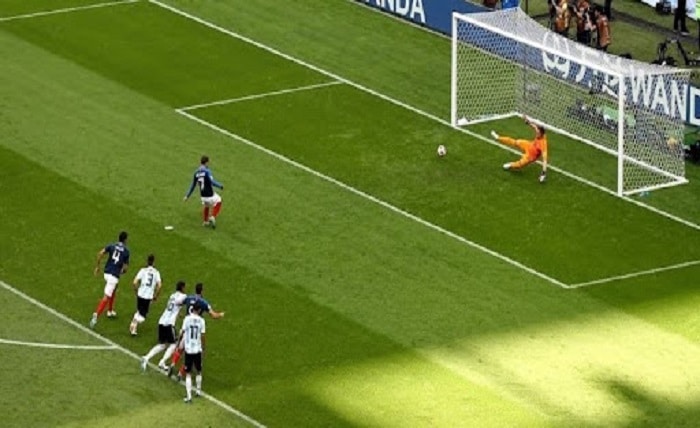
Penalty shootout markets condense football into a high-pressure sequence shaped by conversion rates, shot placement, goalkeeper tendencies, and kicking order. Live prices also react sharply to every save or miss, creating a market where timing matters as much as pre-match analysis. Track spot-kick data and follow sharper knockout betting angles with 8XBET.
Game-theory mechanics and primary penalty shootout strike distributions
At 8xbet , Penalty shootout on evaluating shooter tendencies against goalkeeping movement patterns requires modeling mixed-strategy equilibrium models across high-pressure knockout deciders. Examining these mathematical variables highlights consistent conversion discrepancies before bookmakers adjust their live pricing boards.
Mixed-strategy equilibrium and natural-side strike probabilities
Game theory dictates that shooters must balance their strike directions unpredictably to prevent goalkeepers from exploiting positional tendencies. Right-footed kickers select their natural side (the goalkeeper’s right) in 61% of high-stress kicks during an official penalty shootout, converting those attempts at a 78% efficiency rate.
Central elevation strikes and goalkeeper non-jump bias
Striking firmly into the upper third of the central goal sector produces a conversion probability exceeding 94% across international competitions. Shooters who direct rising strikes centrally exploit this dive bias effortlessly, taking advantage of goalkeepers who vacate the center before ball contact.
Terminal strike velocities exceeding 105 km/h
A spot-kick delivered at a velocity of 105 km/h crosses the 11-meter distance in approximately 0.38 seconds, severely testing physical human reaction limits. When an attacker strikes cleanly with optimal velocity during a penalty shootout, a goalkeeper guessing the correct corner still fails to make a save in 82% of charted attempts.
Run-up angle variations and deception telemetry
Shooting approaches featuring run-up angles greater than 35 degrees allow players to disguise their hip rotation until the plant foot anchors into the turf. This brief lateral hesitation degrades the keeper’s diving power, cutting their reach toward the side netting by up to 25 centimeters.
Goalkeeper anticipation telemetry and dive execution metrics
Goalkeepers turn into high-leverage assets when match regulations push knockout ties beyond 120 minutes of exhausting extra time. Analyzing historical dive metrics demonstrates how individual goalkeeping skill directly decides a contested on the international stage.

Goalkeeper save telemetry dashboard tracking penalty spot kick angles
| Goalkeeper Metric / Technique | Key Benchmark | Penalty Shootout Impact | Analytical Insight |
| Historical Save Percentage | 22%-28% for top-level tournament keepers; recreational average around 16% | A proven penalty specialist can increase squad advancement probability by up to 14% | Historical save rates and directional dive charts help identify reliable penalty-stopping specialists |
| Asymmetrical Positioning & Baiting | Keeper positions 1015 cm off-center; approximately 68% of shots may be directed toward the intentionally exposed side | Predetermined directional commitment can increase clean parries by about 29% | Pre-kick positioning can reveal psychological traps designed to influence the shooter’s target |
| Stance Stability & Delayed Reaction | Save rate reaches around 34% on shots placed within 1.5 meters of the goalkeeper | Staying grounded longer improves reactions to central chips, late placement changes, and close-range strikes | Stable footing and limited premature movement preserve lateral and vertical explosive power |
| Rebound Containment & Parry Direction | Priority is redirecting the ball beyond the post or over the crossbar | Safe deflections reduce the risk of spinning or rebounding balls crossing the goal line | Parry mechanics indicate how effectively a keeper controls dangerous shot trajectories during decisive kicks |
Game-state dynamics and live in-play shootout proposition trading
Live betting terminals open fast-moving proposition lines the moment the final whistle of extra time confirms the onset of spot-kicks. Navigating these split-second odds adjustments on a live penalty shootout requires rapid quantitative evaluation and decisive market timing.
The critical first-kick advantage and ABAB sequence dynamics
Statistical historical analysis confirms that the squad shooting first in an alternating ABAB format secures tournament victory in 60.5% of completed deciders. Taking an early lead transfers severe psychological pressure onto trailing kickers, whose conversion rates drop by 9% when facing immediate elimination.
Sudden-death conversion drops beyond the fifth round
Once a contest surpasses the initial five-round framework, secondary shooters like fullbacks and central defenders must step up to the spot. Conversion rates in a prolonged penalty shootout plunge from 76% down to 64% during sudden-death rounds as non-specialist players face overwhelming emotional tension.
Order-of-taker optimization and anchoring strategies
Managers organize their kicking order deliberately, positioning their most reliable finishers in the first and fifth slots to secure early momentum and close out decisive moments. Astute punters review the confirmed five-man kicking lineup within two minutes of the final whistle to spot vulnerabilities in the opposing order.
Live hedging during late multi-round momentum swings
Dynamic live betting boards recalibrate violently after a single miraculous save or missed strike in the third round. Traders holding pre-match advancement tickets utilize these momentum swings during a penalty shootout to deploy counter-stakes and lock in guaranteed returns across both outcomes.
Psychological pressure variables and historical performance curves
The emotional burden of representing a nation or club in an elimination decider alters motor skills and muscle memory under physical exhaustion. Evaluating these psychological friction points illustrates how a penalty shootout unfolds across major international tournament fixtures.
Tournament fatigue degradation following 120 minutes of play
Enduring two hours of high-intensity football depletes glycogen reserves and degrades cognitive processing speeds across both teams. Players taking a kick in a penalty shootout after playing 120 continuous minutes experience a 14% higher rate of off-target strikes compared to fresh substitutes.
Physical fatigue causes kickers to lean backward upon ball contact, sending high-powered attempts flying harmlessly over the crossbar. Factoring average player mileage and muscle cramping into spot-kick models improves forecasting precision on total shootout misses.
Host-nation pressure versus hostile away crowd noise
Shooting toward a stadium end packed with hostile opposing supporters introduces intense acoustic distraction and cognitive disruption. Visiting teams facing massive crowd hostility record an average conversion rate of just 69%, compared to 77% for the home side.
The auditory roar of tens of thousands of whistles disrupts the kicker’s pre-shot routine, accelerating their approach before the referee’s whistle fully fades. Incorporating venue acoustics and fan proximity into match models exposes value on home-nation advancement lines.
Historical shootout trauma and national team precedent
Certain national teams suffer from documented psychological trauma in knockout deciders, enduring multi-decade losing streaks that weigh heavily on active squads. A side carrying a history of losing in a penalty shootout converts under-pressure kicks at an 11% lower rate during crucial sudden-death attempts.
This historical baggage manifests as visible physical hesitation and rushed strikes from younger players burdened by past failures. Factoring psychological team precedent into analytical models identifies persistent pricing discrepancies across tournament futures.
Goalkeeper visual disruption and intimidation antics of penalty shootout
Goalkeepers utilize psychological games, ball-handling delays, and theatrical goal-line movements to break the concentration of oncoming kickers. Delaying a kick by 15 seconds during increases the shooter’s heart rate, elevating the probability of a missed or saved strike by 21%.
Match officials enforcing modern conduct rules routinely restrict these physical antics, penalizing aggressive movement before the kick. Monitoring how officials manage goalkeeper conduct reveals whether defensive gamesmanship will disrupt oncoming shooters.
Conclusion
Penalty shootout analysis combines game theory, goalkeeper behavior, player psychology, and live market movement to assess the outcome of knockout deciders. Shot direction, conversion history, and sudden-death trends provide useful signals for evaluating advancement prices. Read the numbers, monitor every round, and sharpen your selections with thể thao 8xbet.