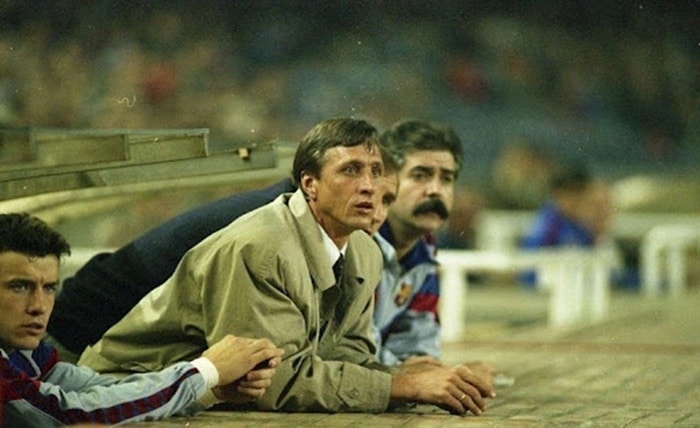
Coach Johan Cruyff is remembered not only as a legendary player but also as a strategist who had a profound influence on modern football. From Ajax to Barcelona, he developed a philosophy centered on possession, intelligent movement, and proactive attacking play. According to 90Phut TV, Cruyff’s influence can still be clearly seen in the way many teams organize their play today.
Johan Cruyff: From Football Legend to Great Manager
Before becoming a renowned coach, Johan Cruyff had already built an illustrious playing career. His experience with Total Football provided the foundation for a distinctive tactical vision when he moved into coaching.
Successful Years at Ajax
Cruyff began his coaching career at Ajax in the mid-1980s. It was an ideal environment for him to experiment with ideas he had absorbed while playing under the guidance of Rinus Michels. Cruyff wanted his team to control matches through technical ability, well-balanced team spacing, and quick ball circulation.
Rather than building a system focused primarily on defense, he asked his players to actively retain possession and create numerical advantages in different areas of the pitch. This philosophy quickly helped Ajax develop a distinctive style. Fans following kenh truc tiep bong da dem nay today can still recognize many similar tactical principles being applied by European clubs.
Barcelona and a Turning Point in His Coaching Career
In 1988, Cruyff returned to Barcelona as head coach. This marked the beginning of the most important chapter of his managerial career. Coach Johan Cruyff began rebuilding the team from its training methods and player recruitment to its approach to playing out from the back.
He did not simply want Barcelona to win; he wanted the team to win with a clear identity. The players were instructed to build from the back, use the full width of the pitch, and constantly create passing triangles. According to 90 Phút TV, this was the period that laid the foundations for Barcelona’s famous possession-based identity in the years that followed.
The Birth of Barcelona’s Dream Team
In the early 1990s, Barcelona under Cruyff became known as the Dream Team. The squad featured outstanding players such as Ronald Koeman, Michael Laudrup, Hristo Stoichkov, Pep Guardiola, and José Mari Bakero.
What stood out was not only their individual quality but also how Cruyff connected them into a unified system. Barcelona repeatedly dominated domestic competitions and became one of the most entertaining teams in Europe. The team’s achievements during this period regularly placed them near the top of the bảng xếp hạng bóng đá, while also establishing a new standard for how a major club could control matches.
The Distinctive Football Philosophy of Coach Johan Cruyff
What made Coach Johan Cruyff different was the way he viewed space, time, and possession. For Cruyff, keeping the ball was not the ultimate goal but rather a means of controlling the entire match.
Possession as a Means of Controlling the Game
Cruyff believed that when a team had possession, the opponent could not score. However, his philosophy was not simply about making as many passes as possible. Players had to constantly provide passing options, maintain appropriate distances, and know how to move before receiving the ball.
This system required a high level of tactical intelligence because every player was involved in building the team’s style of play. These principles later had a major influence on Pep Guardiola and many other possession-oriented coaches. When watching matches through 90m TV, fans can easily recognize Cruyff’s influence in teams that prioritize building attacks from the back.
Making Full Use of the Width of the Pitch
Another element Cruyff placed particular emphasis on was width. Wingers had to position themselves wide enough to stretch the opposition’s defensive structure, thereby creating space in central areas.
When the distance between opposing defenders increased, technically gifted midfielders had more room to receive the ball and play decisive passes. This approach gave Barcelona multiple attacking options instead of making the team dependent on a single individual. It is also a common principle among many teams leading the bảng xếp hạng bóng đá in top domestic competitions today.
Valuing Intelligent Players Over Physical Attributes
Cruyff did not place physical size at the top of his criteria when selecting players. He cared more about awareness, quick ball control, and positional understanding. A player who knows where to position himself and when to make a pass can provide greater value than someone who relies solely on speed or strength.
Pep Guardiola is a prime example. As a young player, Guardiola was not particularly strong in physical duels, but he possessed an exceptional ability to read the game. Cruyff gave him an important role in midfield, helping shape the deep-lying playmaker profile that became influential later on.
The Greatest Achievements of His Managerial Career
Coach Johan Cruyff’s career at Barcelona was closely associated with an exceptional period of success. He not only brought trophies to the club but also created a team with a style capable of influencing generations to come.
During his time in charge of Barcelona from 1988 to 1996, Cruyff led the club to four consecutive La Liga titles from the 1990/91 through 1993/94 seasons. His most important achievement was winning the European Cup in 1992, the predecessor of today’s Champions League.
In the final at Wembley, Barcelona defeated Sampdoria 1–0 after extra time thanks to Ronald Koeman’s famous free kick. It was the first time the Catalan club had won the European Cup.
For viewers following kenh truc tiep bong da dem nay, the Champions League is now a familiar competition for Barcelona, but the 1992 triumph was a particularly important milestone that helped transform the club’s standing in European football. 90P TV considers this period a crucial foundation for the successes Barcelona would achieve in the following decades.
Johan Cruyff’s Legacy in Modern Football
The value of Coach Johan Cruyff goes far beyond the number of trophies he won. More importantly, he developed a football philosophy capable of surviving and evolving across generations.
Cruyff had a major influence on the way Barcelona developed young players. La Masia emphasized technical ability, positional awareness, and combination play in tight spaces. Many players who came through this system later became key figures for the first team.
Pep Guardiola is perhaps the clearest successor to Cruyff’s ideas. When Guardiola took charge of Barcelona in 2008, he developed Cruyff’s principles of possession and pressing to a new level, creating a famous team featuring Lionel Messi, Xavi, and Andrés Iniesta.
Cruyff’s influence has also appeared at many European clubs beyond Barcelona. Goalkeepers participating in build-up play, center-backs moving higher up the pitch, full-backs moving into central areas, and players constantly exchanging positions all have connections to the spatial concepts he championed. According to 90 Phut, it is this lasting influence that makes Cruyff one of the most important figures in the history of football tactics.
Conclusion
Coach Johan Cruyff went far beyond the conventional role of a manager by creating a philosophy that influenced Barcelona and modern football for decades. His principles surrounding possession, space, and player development remain highly relevant. By following 90Phut, fans can continue to see Cruyff’s legacy reflected in the playing styles of many of today’s leading football teams.